


Financial advisory firms can boost operational efficiency, reduce risk, and maintain a client-first focus by prioritizing daily tasks, automating repetitive workflows like money movement, utilizing AI for meeting notes and outsourcing time-consuming tasks like vendor management.
These targeted strategies eliminate manual work without requiring a massive tech overhaul.
How can financial advisory firms streamline their day-to-day operations and improve productivity using automation and artificial intelligence?
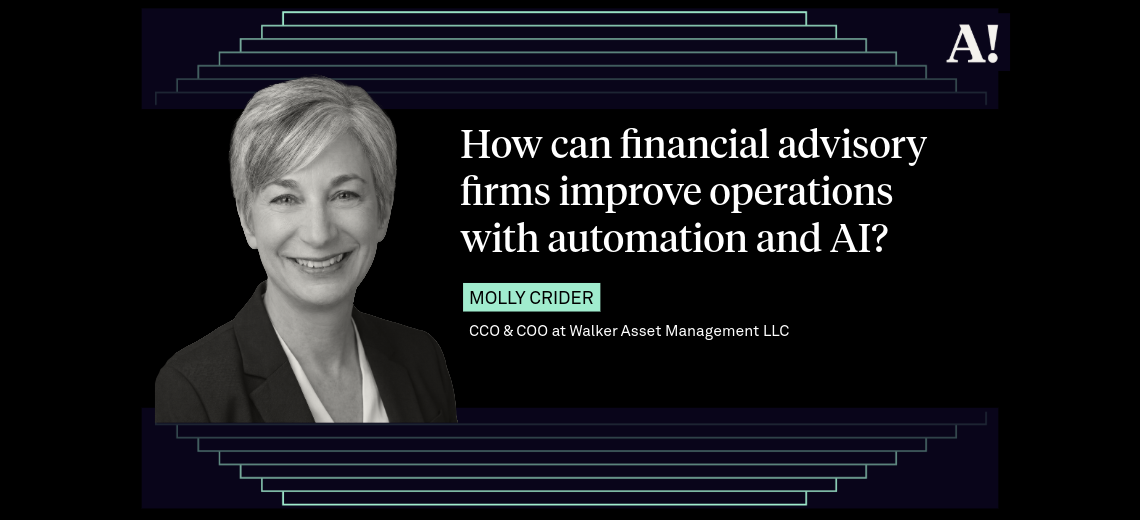
In this episode of Action!, host Suleman Din (Advisor Intelligence Lead at AdvisorEngine) sits down with industry veteran Molly Crider (CCO & COO at Walker Asset Management LLC) to discuss practical operational strategies for modern wealth management firms.
Key topics covered
- Daily productivity frameworks: How to set up structured daily systems and prioritize core client tasks without getting overwhelmed.
- Workflow automation: Building step-by-step processes to mitigate compliance risks, avoid fraudulent activities, and maintain operational consistency.
- AI integration: How tools like AI meeting note-takers (e.g., Zeplyn) can be integrated into investment reviews and client interactions to save time.
- Vendor management: Evaluating operational tasks and identifying what processes are best outsourced versus managed in-house.
Featured speakers
- Suleman Din – Advisor Intelligence Lead at AdvisorEngine & Editor-in-Chief of Action! Magazine
- Molly Crider – Chief Compliance Officer & Chief Operations Officer at Walker Asset Management LLC
Frequently asked questions
- How do wealth management firms prioritize daily operational tasks? Establish a morning routine by logging into your custodian, CRM/Tech platform (like AdvisorEngine), and email to filter out urgent client needs first, then focus on top-priority tasks.
- How does workflow automation protect advisory firms? Automating repeatable workflows ensures step-by-step compliance, reduces human error during sensitive tasks like money movement, and mitigates cybersecurity or fraud risks.
- What is the benefit of using AI note-takers in financial advisory meetings? AI note-taking software captures detailed client context automatically during meetings, synching actionable summary notes into firm workflows and freeing up advisors from tedious manual typing.
Transcript
Suleman Din: Hello and welcome again. My name is Suleman Din. I am the editor-in-chief of Action! magazine and AdvisorEngine’s Advisor Intelligence Lead. We’re continuing our series of conversations with operations experts across wealth management, and I am very fortunate and lucky and happy today to have Molly Crider from Walker Asset Management. Good morning, or should I say good afternoon, Molly. How are you?
Molly Crider: I'm doing well. How are you?
Din: I'm doing excellent. Thank you so much for joining me today. Molly is a 20-year veteran in the wealth management space. She's the chief compliance officer and chief operating officer of Walker Asset Management. Spent a long time at Morgan Stanley before joining our good friend, Robin, at the firm in Arkansas. And we've got a lot to talk about today, and I hope you've come prepared.
Crider: I'm ready. Ready, I'm ready.
Din: Okay, great. So, I think the one question I've been asking everyone about operations is: there's a lot of stuff that happens every day. So what is your ultimate productivity hack for when you're kicking off a crazy week and you've got a busy Monday morning?
Crider: Sure. Those happen a lot, and I think the key is to not be overwhelmed. For me, that has meant kind of establishing a system, so that every morning, I start with kind of the same three things. I'll log into our custodian, log into AdvisorEngine, and open up my emails. Then I filter out the most important things, and I usually choose about three things I need to focus on for the day. On a perfect day, I will get through those, but as you know, from an operational and a compliance side, sometimes you have to pivot, and there are times when those three things might get bumped, or one of them gets bumped to the next day.
Din: Usually, what's in those three items? Are they things that you've prioritized, or are there sort of like a regular bucket that you kind of go to and check and like, "Oh, I've got to pull these things out. These are things we must get done?"
Crider: So for myself, I have a kind of continual to-do list that I'm constantly adding to. There's a lot of compliance tasks that are done quarterly, annually. And then from an operational side, I do have an operations manager, so we obviously look at client needs. Those are prioritized. If she needs any guidance on things, we touch base and make sure she's on track. But it just is kind of making the clients number one, and then working all my other to-do list items in throughout my day.
Din: Now, when you think about the work that you do and the people that you work with, is there one thing that you wish everyone kind of knew or understood about your role better?
Crider: Sure. It's not all just about processing paperwork from an operational standpoint. There are a lot of things that we do, risk management for clients, client experience, and every time we answer an email or answer a phone call, that is reflective of who we are, and what our owner began as this practice. So I think that it's not just processing things. It's not just even going through your Advisor Engine list and checking things off. It's really understanding the role of what you do for the clients and the business.
Din: Would you say that even though it's ops and there's this idea that it's back office, that it's actually there's very much an element of front, it is front-facing for clients?
Crider: Right. I think things have changed so much over the last 10 years. Our firm does not have a brick-and-mortar storefront type service, which we did when I started in the business 20 plus years ago. Everything we do is remote, and computer from home. But we have a very small firm. There are only four of us, and so there's not a day that goes by where one of us isn't speaking to a client, and we all need to be on the same page with that. That is where Advisor Engine has come in very handy because when you have only four people, you want to make sure you know what is happening from each perspective. So capturing those phone calls, those notes, those interactions is key, and we rely on that quite a bit.
Din: Interesting. Service really does make or break an advisory firm here. I think a lot of people, they're trying to accomplish that perfect blend of growth, service, at the same time, balancing costs or whatnot. So, there's a lot of things that have to go right, and then from an operations perspective, all the support, if it's not there, things can easily go wrong. So, from your perspective, when you look at your background and your career of working, what do you think or what-- If there's, like, a most expensive mistake that you've ever seen a firm or a practitioner make that's really stuck out to you as, like, wow, this is something that every firm should really kind of learn from.
Crider: Right. Well, I have two that come to mind. One, from the operational perspective are the horror stories we've all heard about money movement and fraudulent activities. And from a compliance standpoint, I think every firm is always aware and dreading the dreaded cybersecurity breach. Between those two, I think those have been the most costly that we've seen in our industry over the last few years. And so as those come up in the industry, and you have case studies, I think as a firm, we've stepped back and looked at how we can protect ourselves and our clients from both of those happening. And a lot of that for us has been automating workflows. So, another item when things get crazy, if somebody calls in for an urgent money movement request, you may forget off the top of your head to confirm certain things. So we built a workflow out so that we can follow it step by step and not have to think as much and just follow the steps, and that's been huge for us.
Din: Right. I think that was one of the questions I wanted to ask, if there was a single workflow automation that's saved you the most hours, in terms of your team and the work that you guys have to do.
Crider: Yes. I think everything we do, we try to look at it from a workflow point of view. Can we automate this? And if so, how? And sometimes those workflows have to be tweaked as you use them. If certain steps we think might be helpful, we'll add them in. So I think that has been huge for us. Also, for our annual investment reviews with our clients, obviously, we meet with them more, but we do have one where it's very all-encompassing, and we've built out a template for that so that we're covering the same items for each client. And we also, I think the largest time saver for us has been integrating AI software to record those meetings and sync them into those workflows, which is obviously very time sensitive, but it's also helpful so that the advisors aren't typing all of that context in. We get the gist of what was covered during that meeting.
Din: So you're using AI note takers. Is it one in particular, or are you using several? How did you guys build that into the workflow, into the system you have?
Crider: Yeah, sure. We did research several. We're currently using Zeppelin. It's newer for us, just in this calendar year. And so I think we've started by using it for our weekly staff meetings, so that's been very helpful, catching action items that we all need to put into play for the week. But then integrating it into the investment reviews is newer. There is a little bit of acceptance from clients feeling comfortable to be recorded when you call them or do a video meeting, but I think it's becoming more commonplace.
Din: Yeah. How do you explain to them, "Hey, this is just playing in the background. It's completely safe. It's secure. It just makes the work faster?"
Crider: We've used it as, it's really a protection for both of our sides, just to capture the information so that if we need to verify anything, we can go back and make sure that we're doing everything that the client wants. I know that I've personally used my doctor as an example. A doctor visits recently, that's the first question they ask, "Do you mind if I record this?" And so I think people are going to start to see that in different aspects of their life. And for us, it's newer, especially for older clients. There hasn't been a huge jump on board with it yet, but I think we'll start to see that as time goes on.
Din: And for your side, for your team, was it a really big learning curve? I know a lot of tools, they can be very complicated, whatnot, or was it sort of like, this is really quick, we can just put it in here and just turn it on and get it going?
Crider: Right. Well, it's not quite as easy as we thought it might be by just pressing a button, so there is a bit of a learning curve involved. So I think starting off with our weekly Teams meeting was a good way to do it. And I would say that some of us are more on board than others. But just like any technology, I think using it makes you more comfortable with it, and it just becomes more second nature.
Din: Yeah. When you think about all that, so you've added some new technology, you've built in all this workflow automation. It seems to be really working for you guys. So, do you have a recommendation to anyone who's listening who's maybe an ops expert like yourself, one operational task that you think every advisory firm should outsource pretty quickly, if not immediately?
Crider: Sure. I think every firm is different, and so it's hard to say one overall choice. But I know from a small firm, we don't outsource a ton for multiple reasons. But one item that I don't enjoy doing is vendor management. It just seems like it's one of those items that falls to the bottom of my task list. And for me, outsourcing vendor management makes a lot of sense. I know it's necessary, I know it's helpful. But the time to take away from my other duties, it's just a bit of a time suck, and so for me to outsource that is beneficial. Another company may not find that that's the case, so I really think you just need to look at what is the task that you dread and can someone help me with that?
Din: Yeah. How has that been beneficial? It's like you don't have to hunt around, do the research, whatnot. It's kind of like presented out for you. And has it been done in a cost-effective way? You feel good about it?
Crider: It has been. I feel like we have kept our tech stack and certain things pretty minimal. Not for any reason other than we are pretty simple as far as how we go about doing things. However, I think, again, from a time perspective, it's one of those things that you need to do it regularly, you need to do it consistently, and when there are new companies out there, just like these AI note takers, where you need to do your due diligence, the time constraints of looking into all those companies can be done for you. So for me, that's very cost-effective.
Din: All right. Well, Molly, I think we are at the end of today's questions. I know we could keep going here, but I wanted to, first of all, thank you so much for taking some time out of your really busy day to come and talk to us, and I hope this has been a great conversation for you. We've certainly heard a lot of interesting tips, even in a couple of minutes, on ways that you can help improve a business.
Crider: Absolutely. Thanks for having me.
Din: No, my pleasure as always. And for everyone else who's listening in today's call, we have Action magazine. We are regularly publishing articles online. We have a newsletter. We also make it available digitally. If you're coming to Schwab IMPACT this year, you'll have a chance to grab the big magazine that we do once a year in person, so make sure you stop by the Advisor Engine booth. Also, if you're not making it, don't worry. You can easily sign up and subscribe right now for free. It's always free, all of our content. So again, thank you, Molly, so much for coming along to today's show.
Crider: Sure.
Din: And we will see everybody for the next hit.
This blog is sponsored by AdvisorEngine Inc. The information, data and opinions in this commentary are as of the publication date, unless otherwise noted, and subject to change. This material is provided for informational purposes only and should not be considered a recommendation to use AdvisorEngine or deemed to be a specific offer to sell or provide, or a specific invitation to apply for, any financial product, instrument or service that may be mentioned. Information does not constitute a recommendation of any investment strategy, is not intended as investment advice and does not take into account all the circumstances of each investor. Opinions and forecasts discussed are those of the author, do not necessarily reflect the views of AdvisorEngine and are subject to change without notice. AdvisorEngine makes no representations as to the accuracy, completeness and validity of any statements made and will not be liable for any errors, omissions or representations. As a technology company, AdvisorEngine provides access to award-winning tools and will be compensated for providing such access. AdvisorEngine does not provide broker-dealer, custodian, investment advice or related investment services.